
Safe Bite
Jun 29, 2023
Project Scope: 3 Months
Project Type: School Project, Personal
Role: UX Research, UI Design, Usability Testing, Product Design
Tools: Figma, Miro, Paper, Pencil, IoT Physical Prototyping (AdaFruit)
Methods: Need-Finding Interviews, Customer Journey Map, Personas, Speed Dating Prototypes, and Usability Testing
Team Members: Emmy Thompson, Megan Rigney, Stephanie Tong, and Yuru Gong
Introduction
What is Safe Bite?
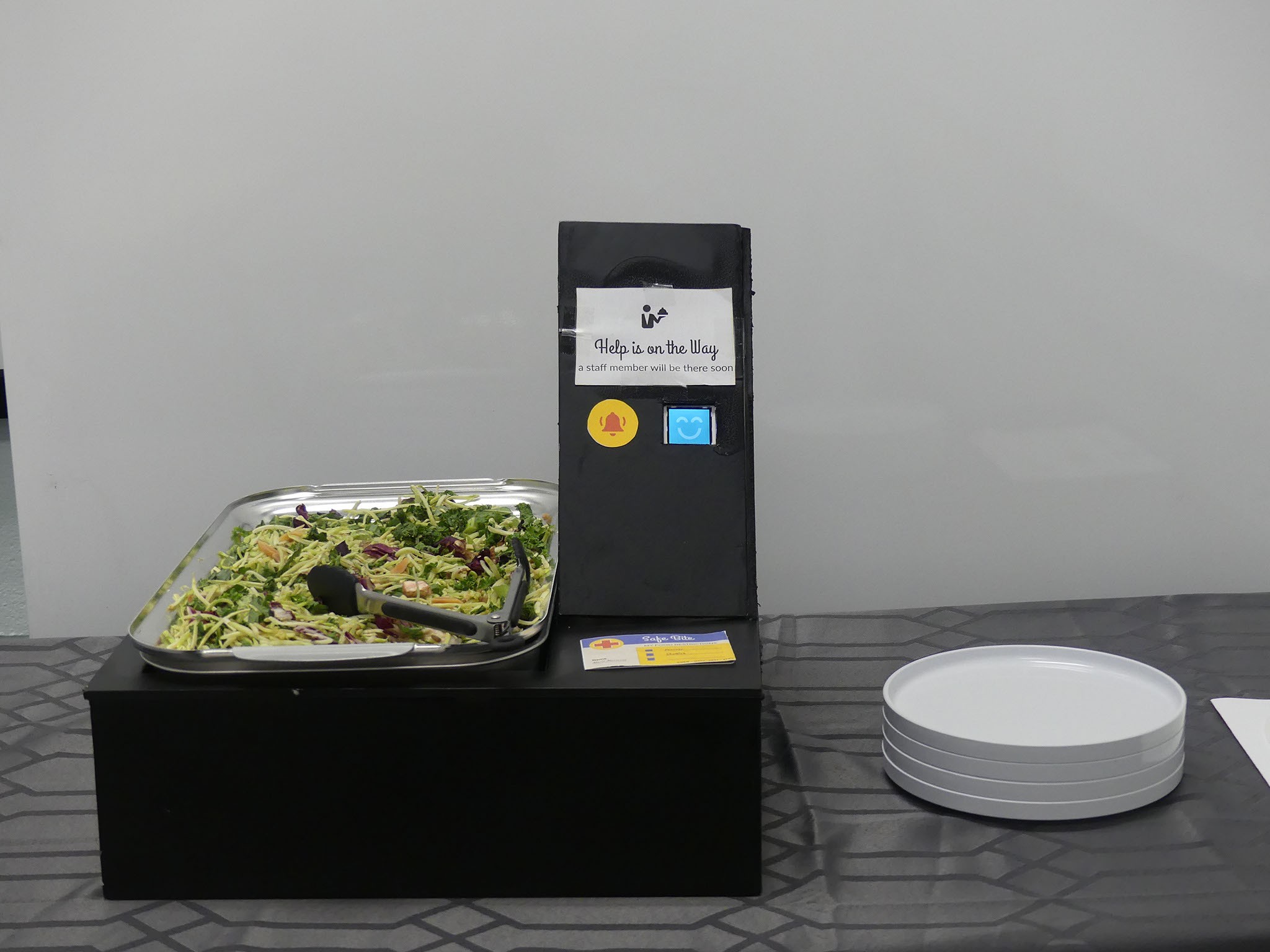
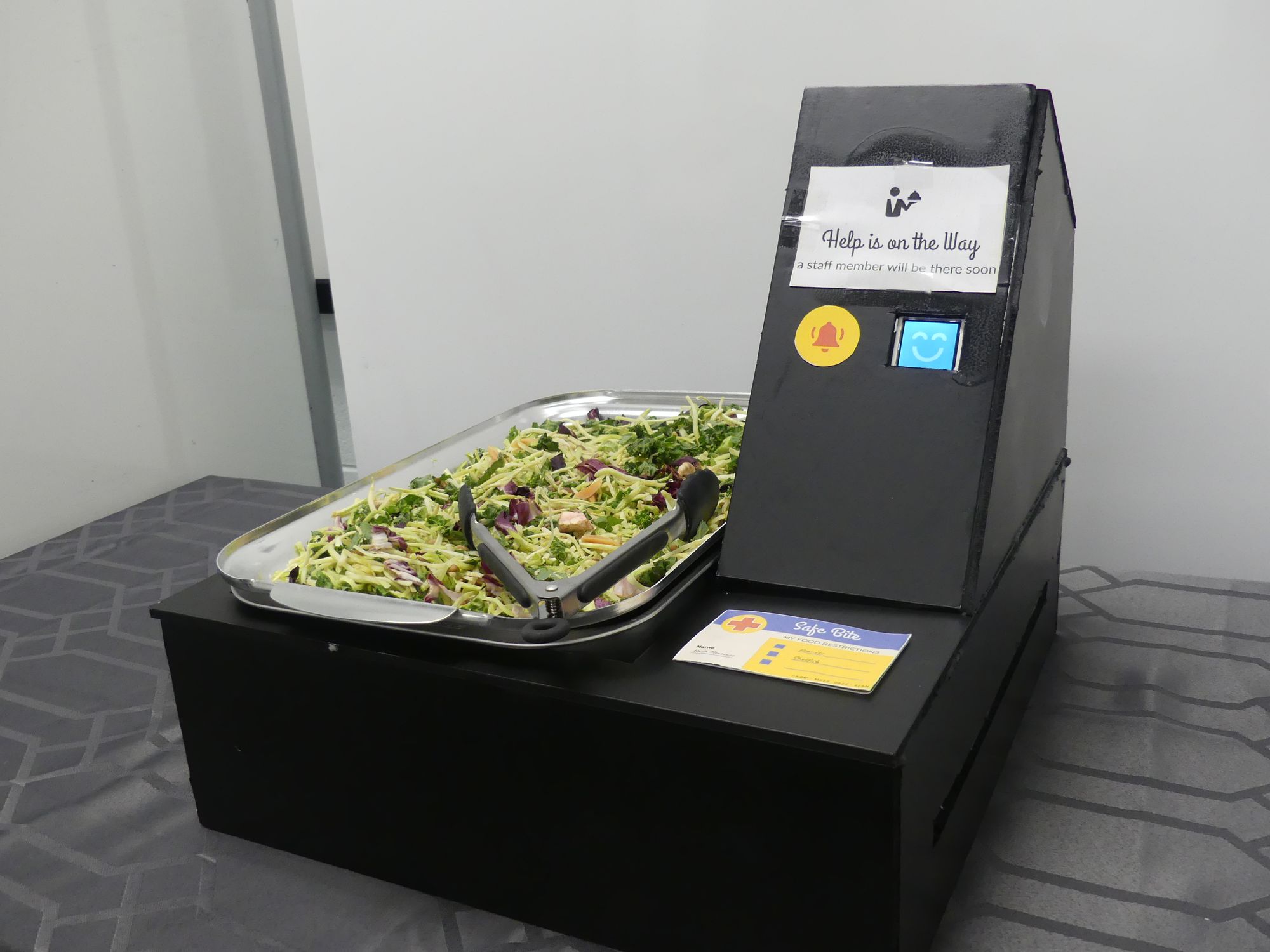
Safe Bite Tray System
Safe Bite operates through
A smart allergy card, owned by the diner, that stores all their food restriction data and is managed through a mobile application
A smart buffet tray that relays food safety through visual signals and additional ingredient information to diners in real time.
Value Proposition
The Safe Bite system elevates a traditional buffet dining experience to help people with food restrictions feel more confident in their ability to dine out safely.
Motivation
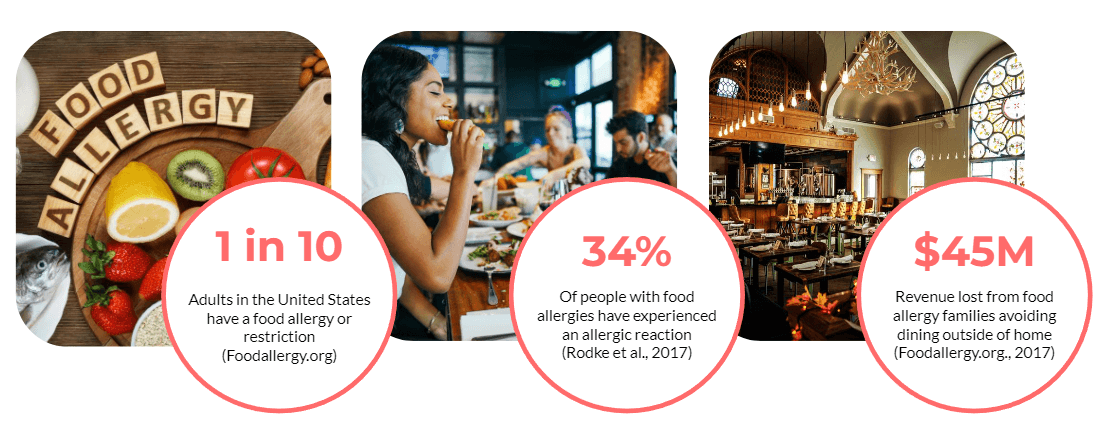
Food allergies and restrictions are a common shared experience in the United States. One in every ten adults has a food allergy or restriction, and approximately 34% of people with food allergies have experienced an allergic reaction in a restaurant. This prevalent issue causes anxiety to dinners and results in $45 Million of revenue lost from food allergy families avoiding dining outside of home. Safe Bite acts as an interactive solution to help improve the dining experience for both diners and restaurant owners.
Key Insights
Formative Study Overview
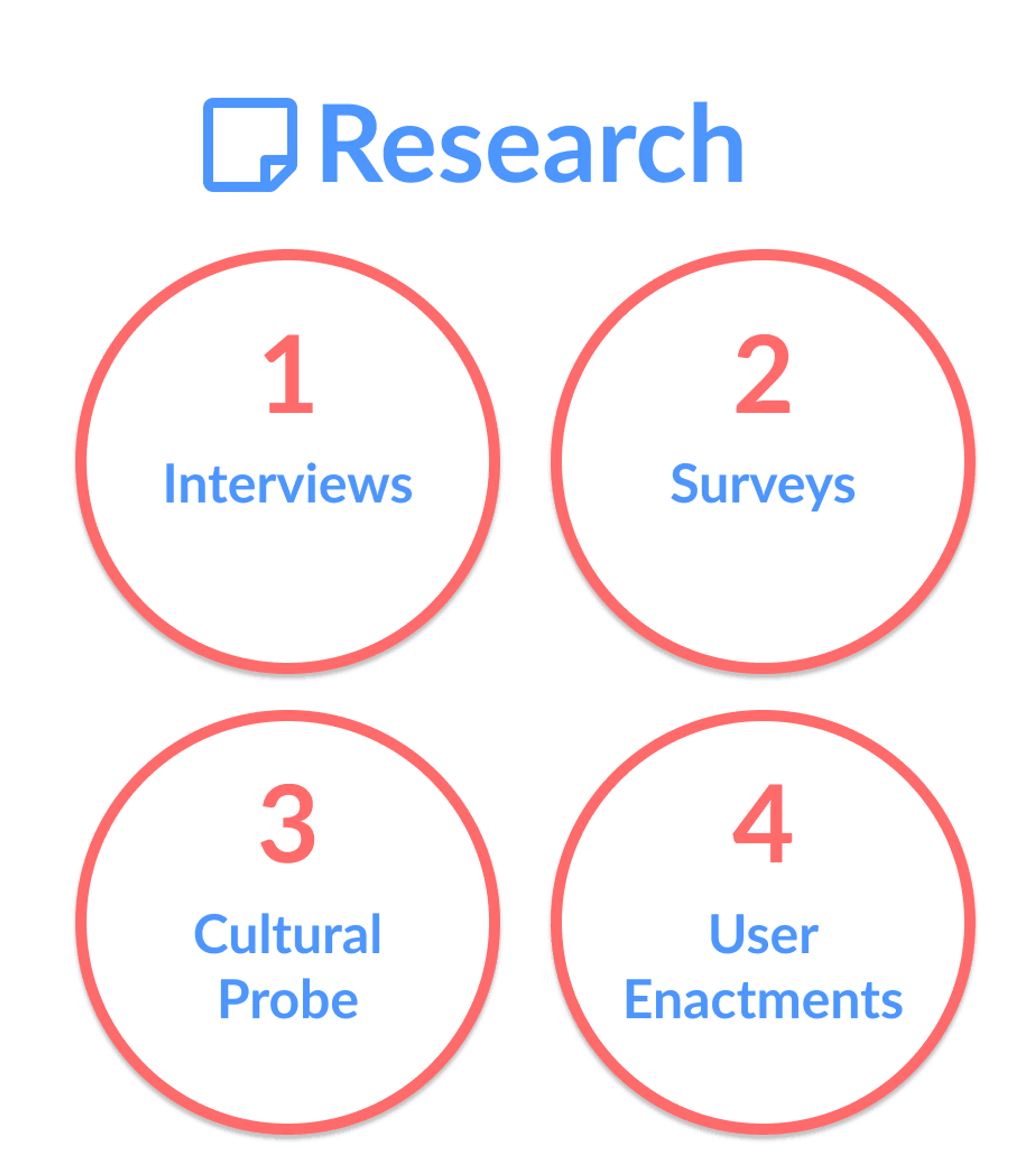
In order to understand the current market and identify user needs and opportunities, we conducted a wide range of research:
Contextual Inquiry: Field observations at 11 restaurants in Ann Arbor. Interviews with 5 diners with food allergies and 1 waiter
Cultural probe: A web-based kit with 3-4 activities, completed by 5 diners with food allergies and 5 restaurant industry members
Survey: 102 survey responses from food allergy participants and 19 from restaurant workers
Formative Study Results
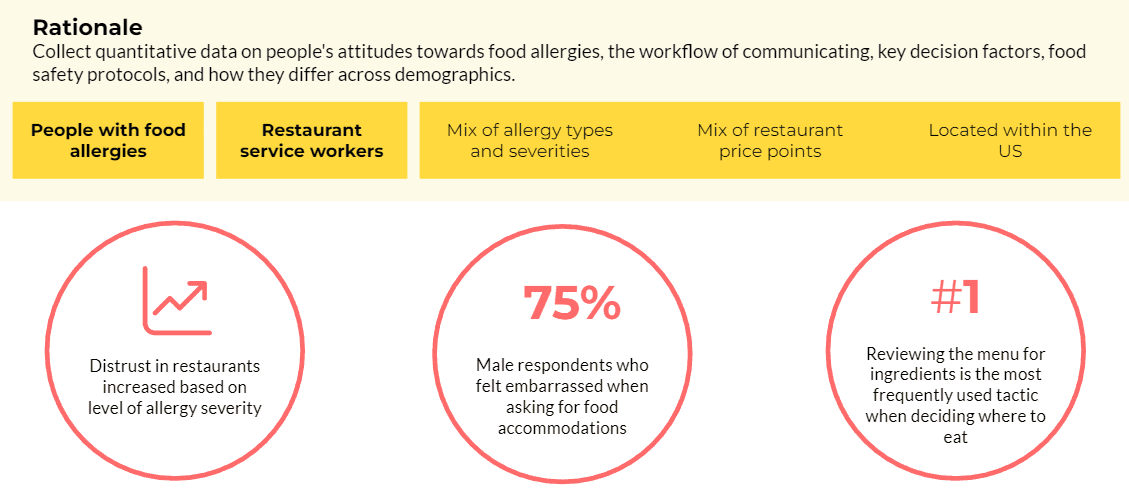
From our research, we found behaviors and sentiment of people with food allergies and restaurant service workers that we could address:
Sentiments: Some people find requesting food accommodations to be an anxious and embarrassing situation and fear coming off as a burden to restaurant staff. Frustration emerge from diners and wait staff primarily due to failures in communication, such as back-and-forth communication between diners, waiters, and kitchen staff (resulting in disruption to the normal service flow), or customers failing to receive confirmation on whether a menu item is safe to eat.
Existing Behaviors: Relying on restaurant ingredient descriptions and other menu symbols to identify safe food options
User Journey
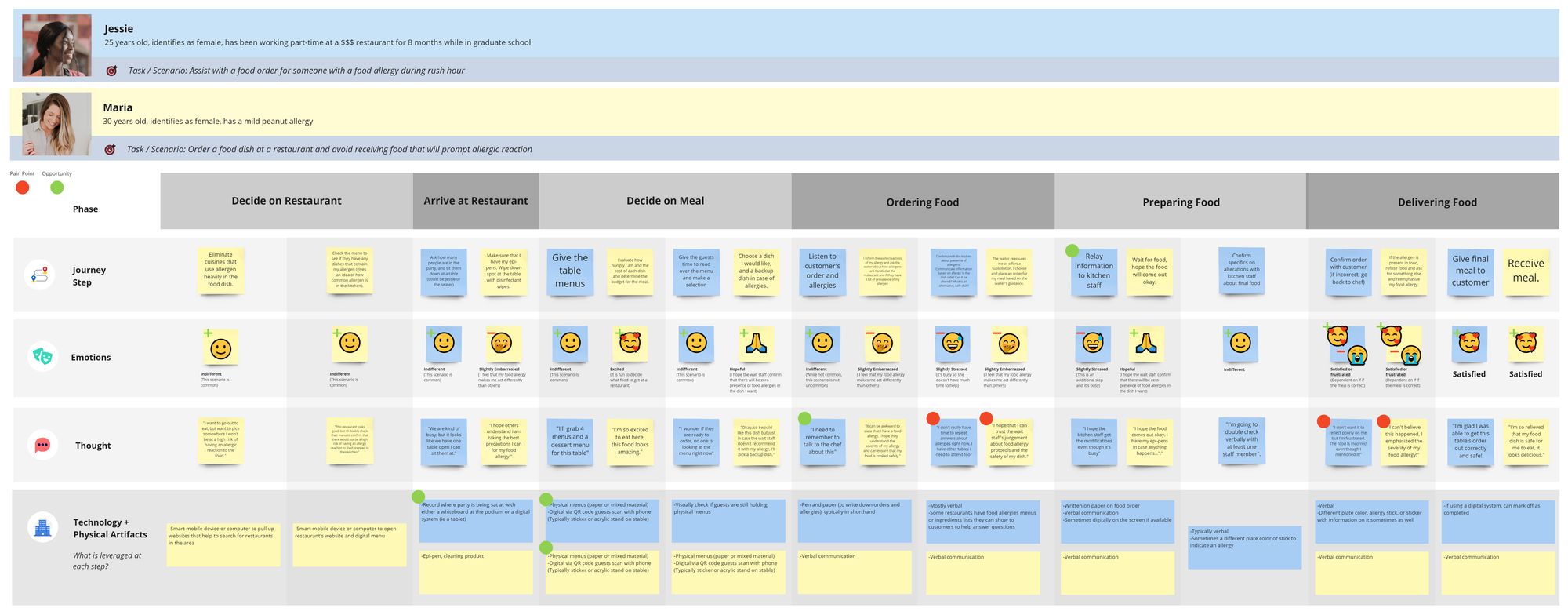
We created a customer journey map based on our personas, Jessie, a restaurant worker, and Maria, a customer with a peanut allergy. While the flow is mostly positive for both personas, there was a common area of negative emotions or stress, resulting in areas of opportunity.
Ordering food can be stressful for both parties, especially when busy. This means the waiter may have less time or patience to answer questions or grab other wait staff for help.
From a guest's side, it can also be frustrating to feel unsure which items are safe to order, how they are made, or to receive little to no confirmation that their food was prepared with their food restrictions in mind. This sometimes results in negative health impacts and avoidance of dining options that are not "sure bets."
Experience Prototype Overview
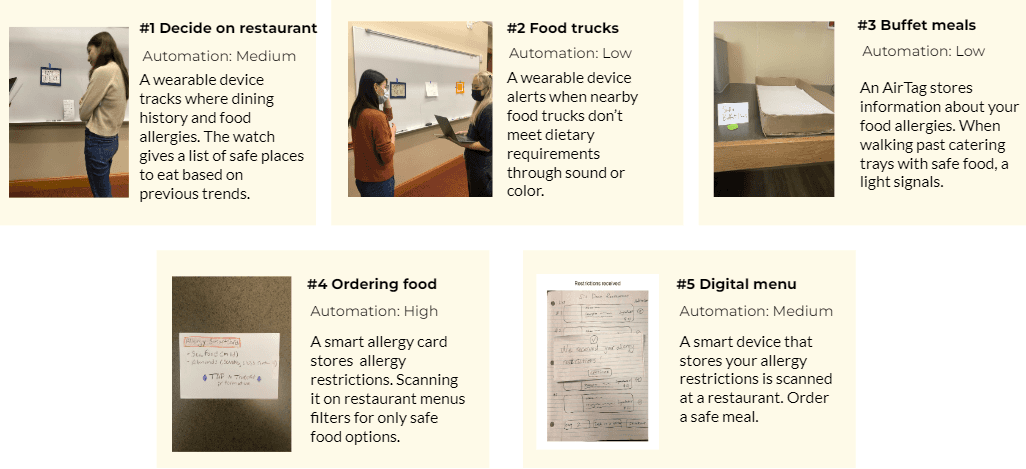
After brainstorming product ideas, our team created 5 prototypes of potential product ideas and tested them through user enactments. These 5 prototypes tested out objects that could be converted to an IoT object. It also explored different dining contexts, such as discovering food trucks or ordering at a sit-down restaurant, as well as different levels of task automation or augmentation.
Our goal with the experience prototypes were to answer the following questions:
What level of automation do people with food allergies desire in making dining choices?
What type of data outputs (visual, written, and tactile) are most successful to provide people with food allergies the allergen information they need?
Should the IoT opportunity live with the user (person with food allergies) or with the business providing the dining experience (restaurant, etc)?
Experience Prototype Results
We found that:
Users prefer IoT functions that are visual or haptic, help speed up decision-making, and operate hands-free.
Users prefer familiar objects related to their every day or dining experience (such as menus or allergy cards), rather than adding a new object to their technology inventory.
Despite technology support, food allergy anxiety is pervasive, and although technology can support decision-making, final decisions still need to lie with the user with food restrictions.
Direction
Based on our research findings, we decided to augment and automate components of the communication flow between customers and wait staff.
An ideal design for the customer would cue safety and ingredient information.
An ideal design for the wait staff would reduce the time needed to answer allergy-related questions.
Despite technological automation, food allergy anxiety is pervasive, and an ideal design will also provide an opportunity for direct communication between wait staff and the customer.
Final System
After we finished conducting research and brainstorming, we landed on Safe Bite: a smart catering system that utilizes RFID technology to assist dinners with food restrictions.
From the diner's perspective, Safe Bite allows users to explore their dining options in a hands free and personalized way without requiring direct interaction with waiting staff (unless specifically requested).
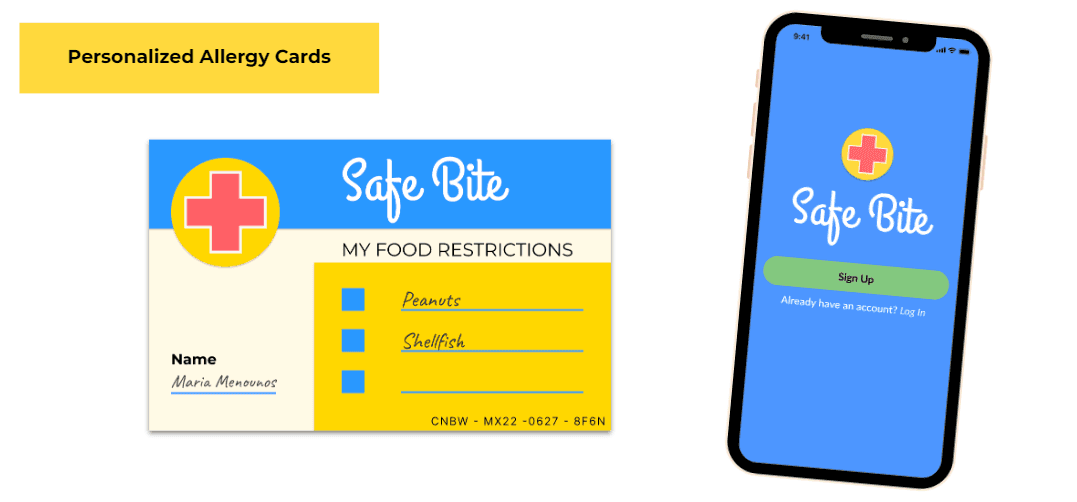
Personalized Allergy Cards
Easy to use iOS application to configure and maintain allergy cards storing personal food restriction data.
Food restrictions can be flexible and can change day by day. Create multiple cards and users to best fit your unique needs.
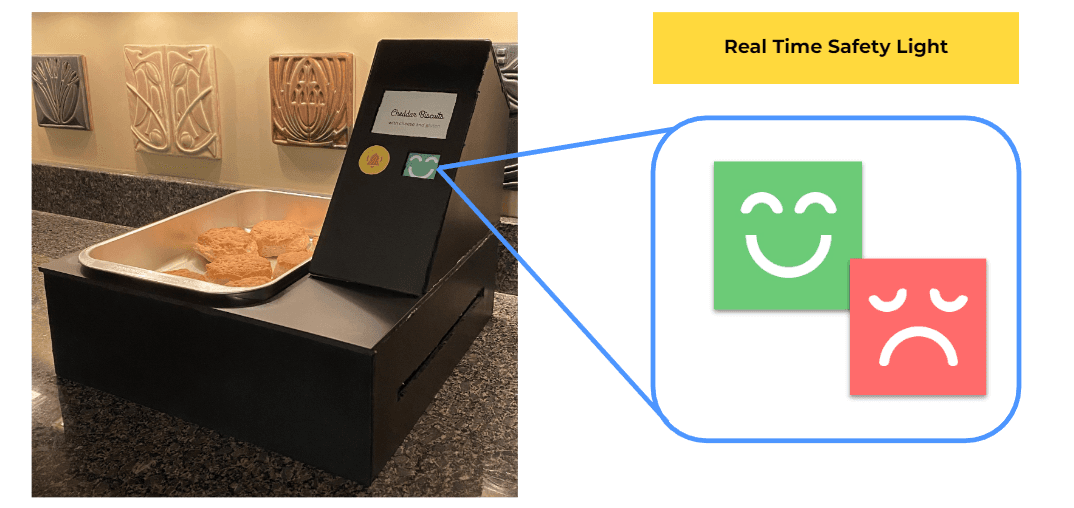
Real Time Safety Light
Walk by a tray to receive a visual, hands free signal to spotlight safe foods personally for you.
Touch the screen to view the ingredient list.
Confirm food safety without ever having to wait to speak to someone!
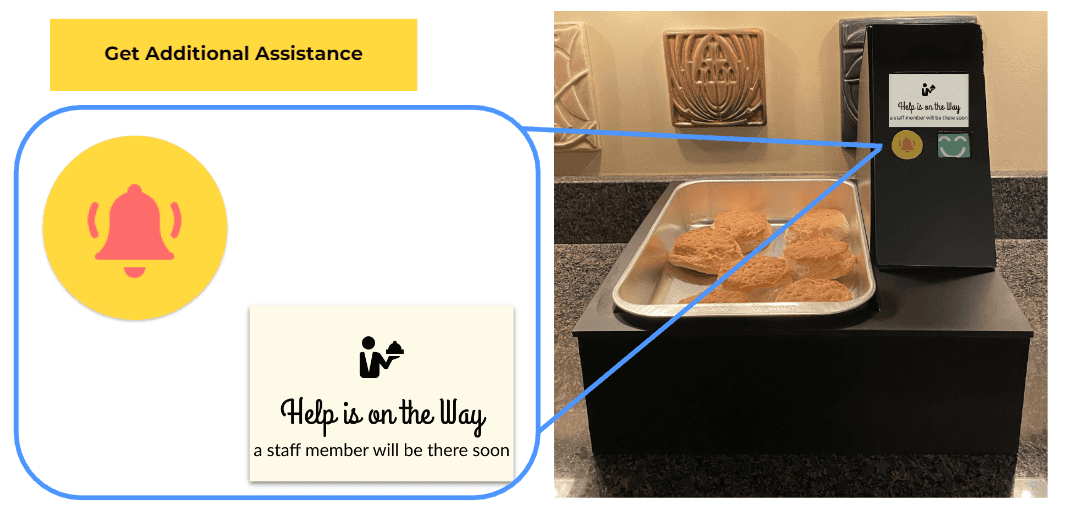
Get Additional Assistance
Still feel like you want to speak to someone to ask a question or get get additional confirmation? Simply press a button to alert a waiter!
No need to awkwardly try to flag down someone for help
Video
Watch Safe Bite in action with this short promo video!
Prototype Shots
Final Prototype
The final tray prototype was created using these components:
Foam core to create the tray stand and computational computing components
Metal tray to hold food
Large and small TFT screen
Safe Bite Prototype Shot, Side View
Computational Computing Components
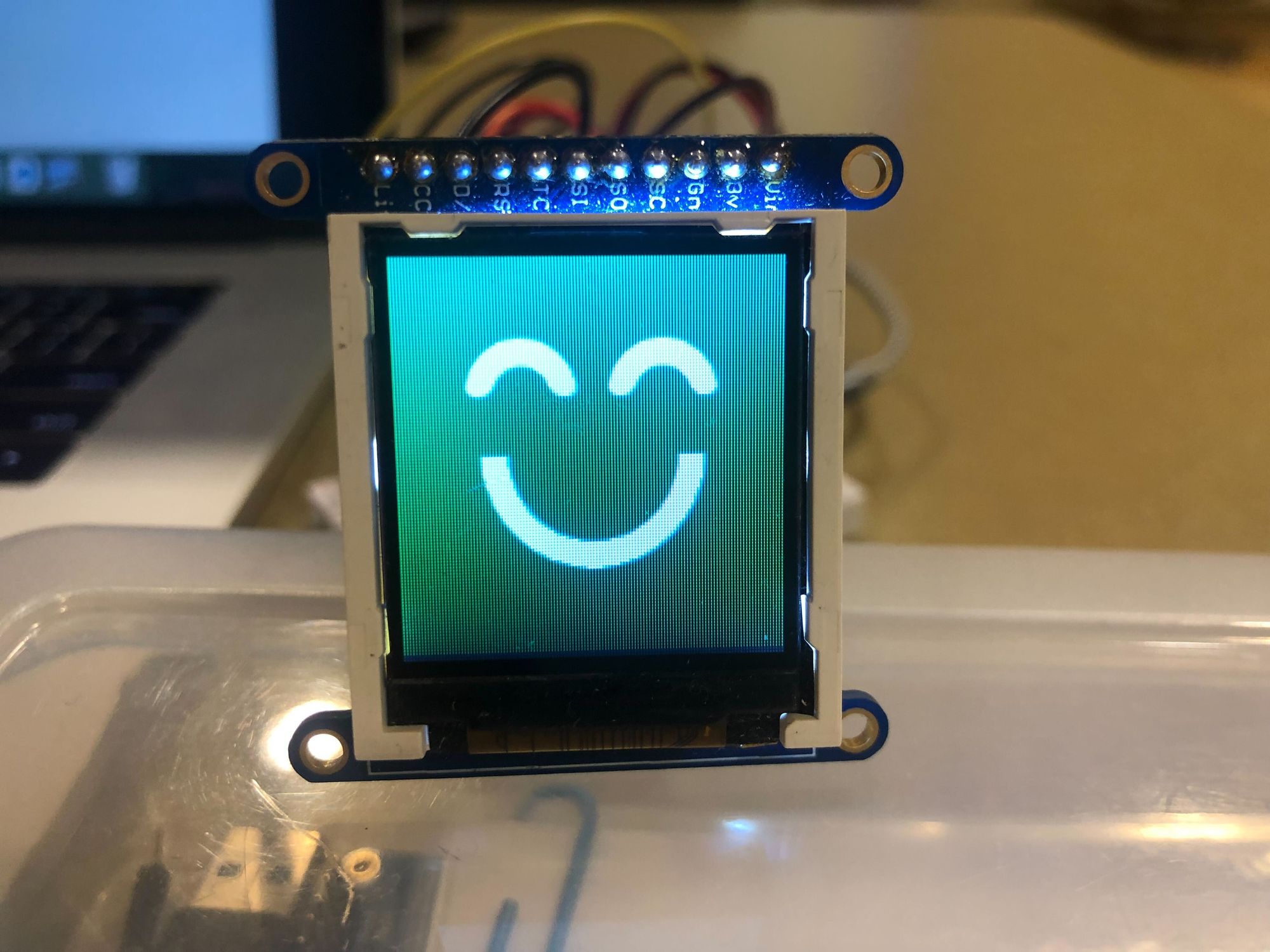
Small TFT screen, green smiley face for safe foods
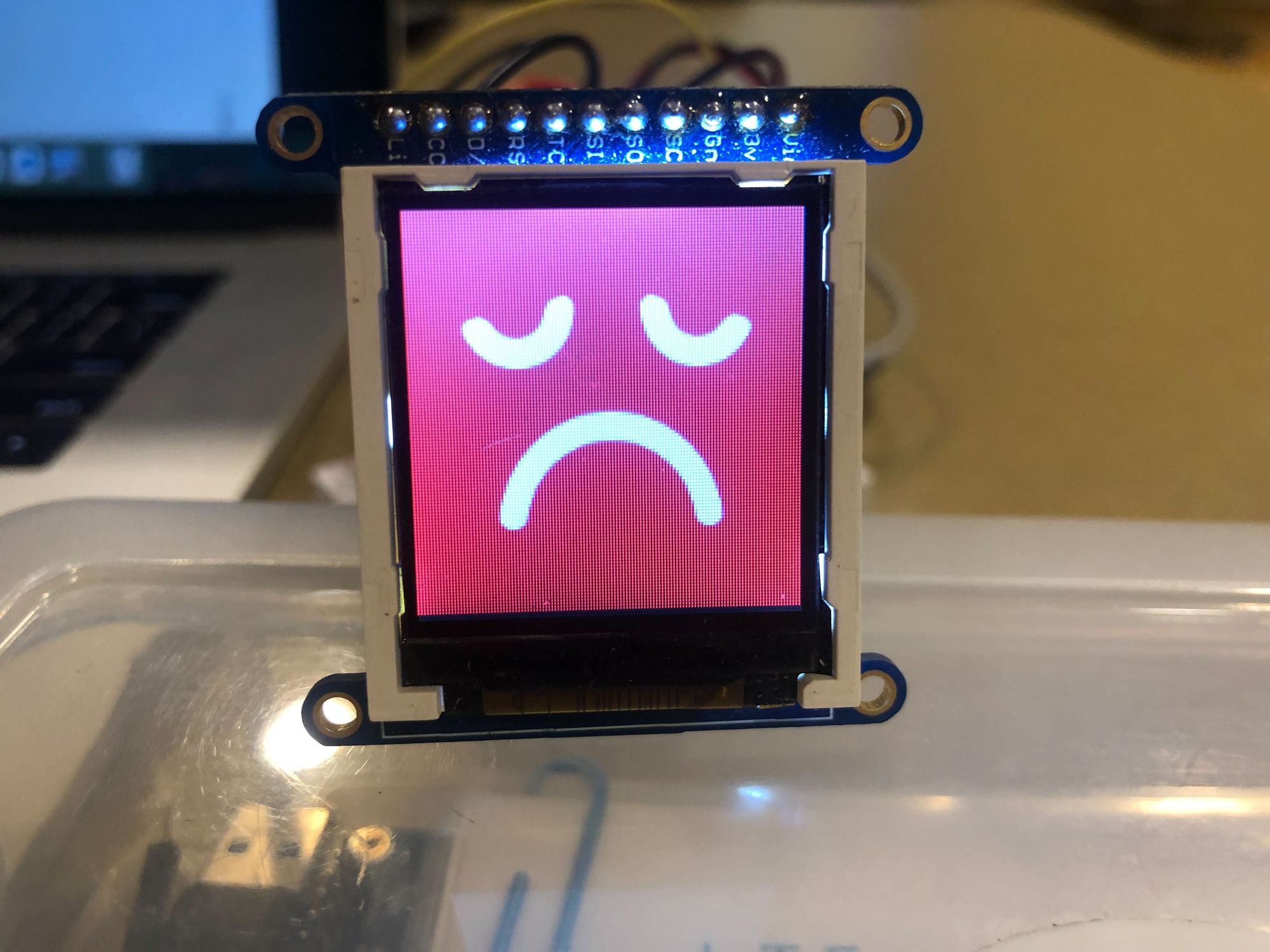
Small TFT screen, red sad face for unsafe foods
Mobile Application
Users can create and customize their allergy cards via our mobile application.
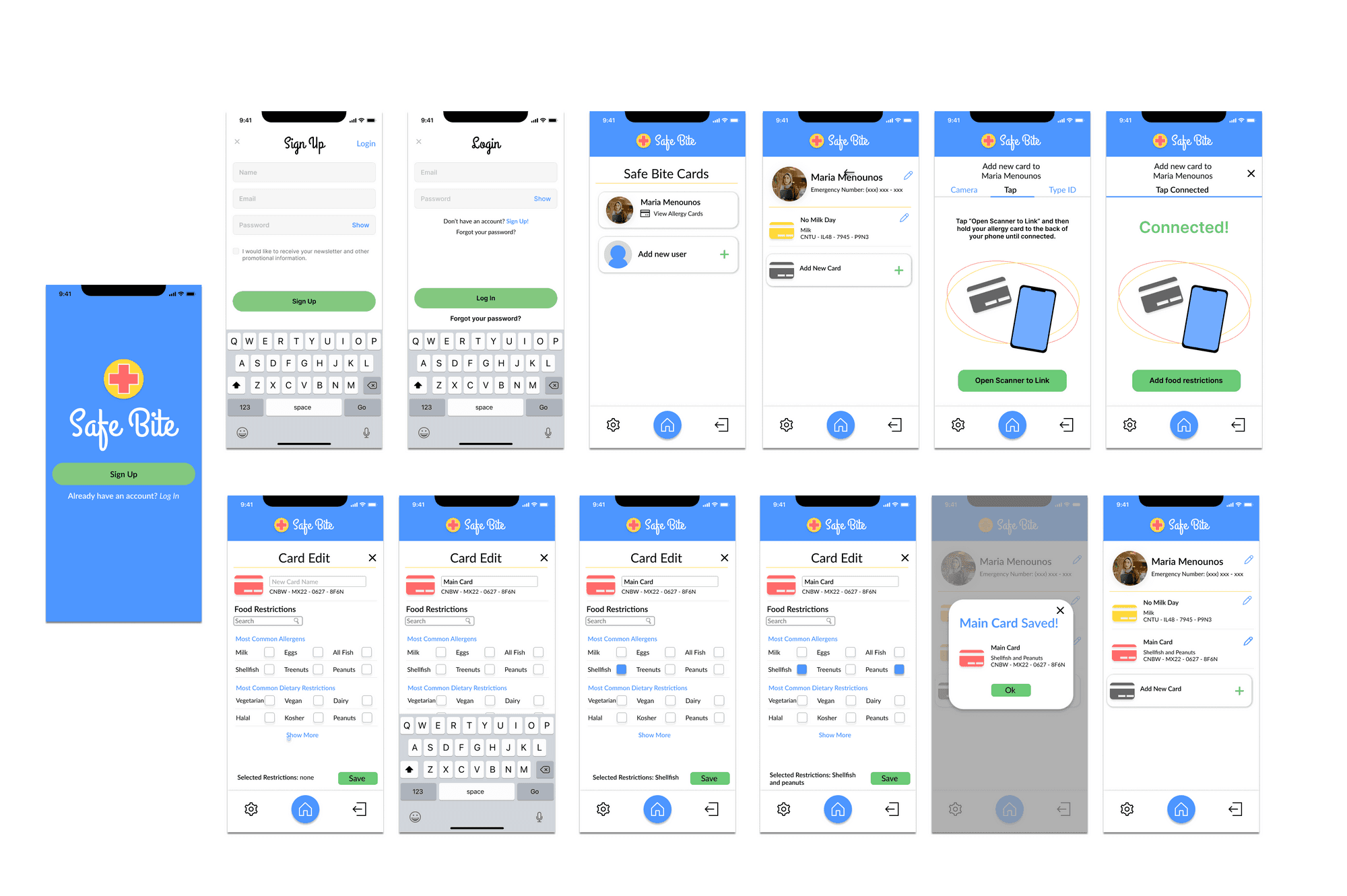
Mobile application wireframes
Try out the mobile application!
Allergy Card
Users connect their physical allergy card to the Safe Bite system via the mobile application.
These cards utilize RFID technology to communicate information between the user and the tray.
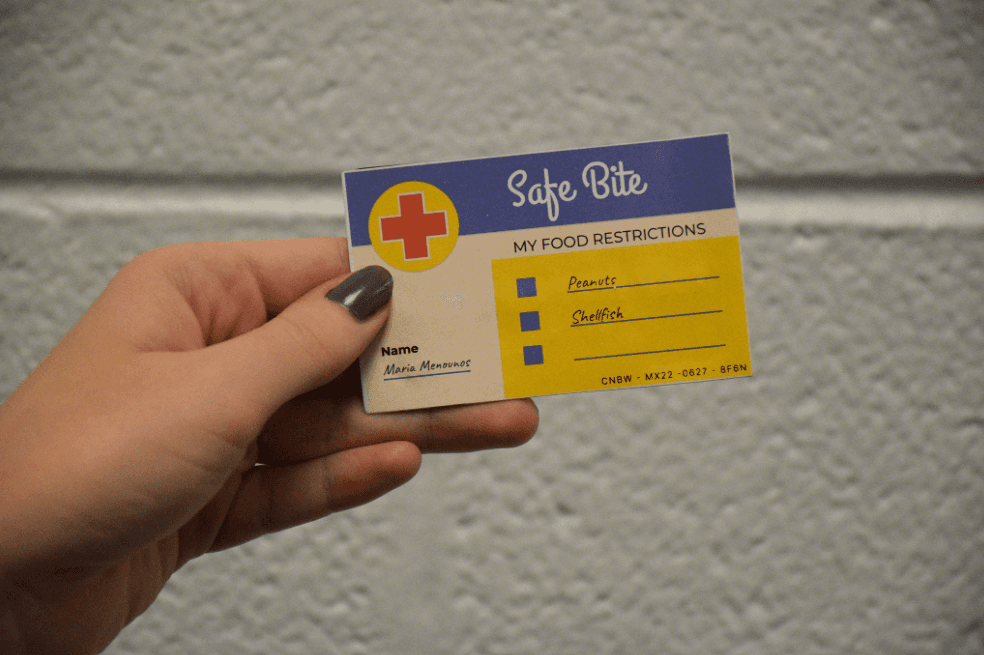
Physical allergy card prototype
Ideal System Proposal
Currently, our demo showcases the diner perspective of our entire system; however, the full system would connect the diner to the buffet restaurant staff / caterer through 3 components: a web application, smart allergy card/iOS app, and the smart catering tray. Both the caterer and the diner would be involved in this system.
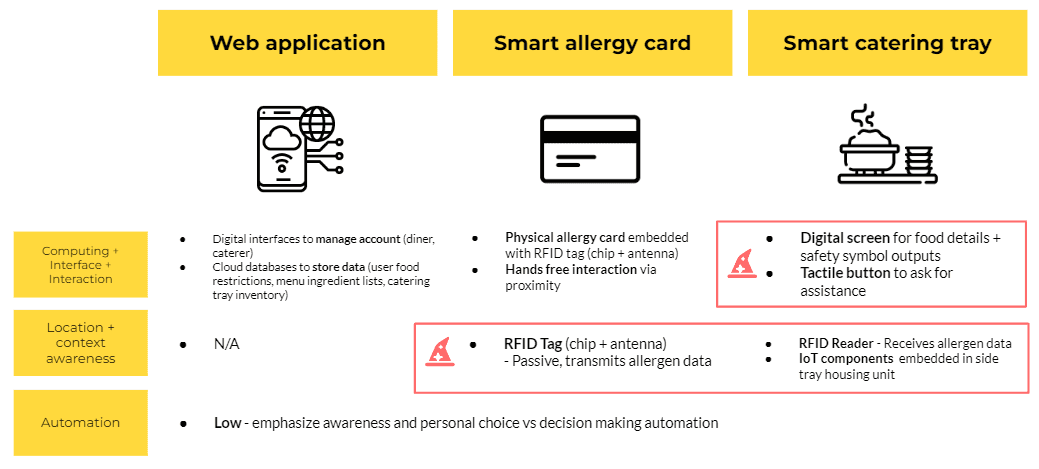
In our demo, the RFID tag in the allergy card, RFID tray reader, and digital screen outputs were controlled using Wizard of Oz techniques. In a finalized version, these would be completely automated through IoT computing.
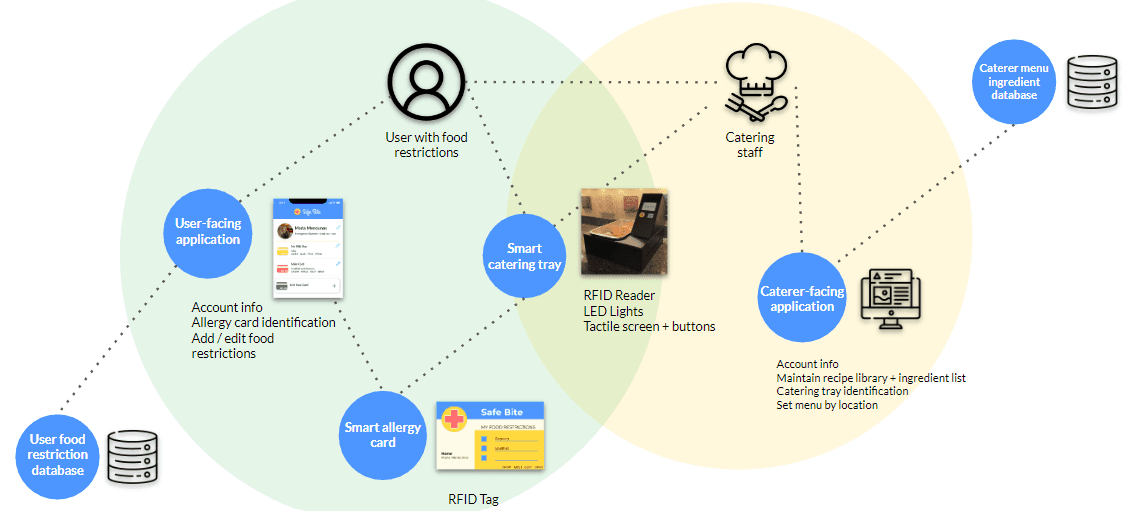
Overall, our ideal system would connect a diner's food restriction database to a caterer's menu database through a series of steps that utilizes the cloud, RFID technology, and digital/tactile interfaces. These connections meet in the middle and are represented by visual changes in the smart catering tray.
Reflection
New Insights
Our team has worked effectively to create an innovative and feasible product that meets the needs of our target audience, people with food allergies. By demoing Safe Bite, we learned new insights about our product.
We observed how a user interacts with the interface in real-time; this helps us explore potential design iterations moving forward. For example, the demo participant pressed the incorrect button to look at the ingredient list - they tapped the red bell help button rather than the large touch screen. Based on this user error, we will consider adding functional labels to the buttons on the Safe Bite device.
We witnessed that Safe Bite is ergonomically comfortable to use. The demo participant had an easy time interacting with the device as the user intended to.
Limitations
We recognize our solution's limitations that should be addressed if product development were to go further.
A functional system can be implemented using an RFID tag, scanner, digital screens, and a digital app. However, the system's performance may not be superior and stable since it requires fast data transmission and restaurant support. Based on our findings, we propose Safe Bite, a futuristic product that can be realized in 5-10 years.
We could emphasize our target audience and conduct a usability test by presenting a live demo of our product. However, our demo presentation is the only usability test we have run with the final product; we should do more tests to identify design iteration needs.
We tested Safe Bite with an adult. To ensure that the device is ergonomically comfortable for all users, we should conduct more usability testing with participants across a wide spectrum of physical builds and heights.
Next Steps
To test the viability of our final product, we need to conduct usability testing for the mobile application and smart catering tray. Then, we can utilize test results to identify the best course of action for design iterations.
We designed our product for our primary target audience of people with food restrictions, specifically allergies. Still, we ought to do market research and usability testing with our secondary audience, caterers, as they would be purchasing and installing the devices.
Before furthering product development, we ought to consider other IoT solutions for people with food allergies that we may be competing with and how our value proposition holds up compared to other products. This competitive market analysis would be critical to understanding our place in the market and proposing buy-in to stakeholders.
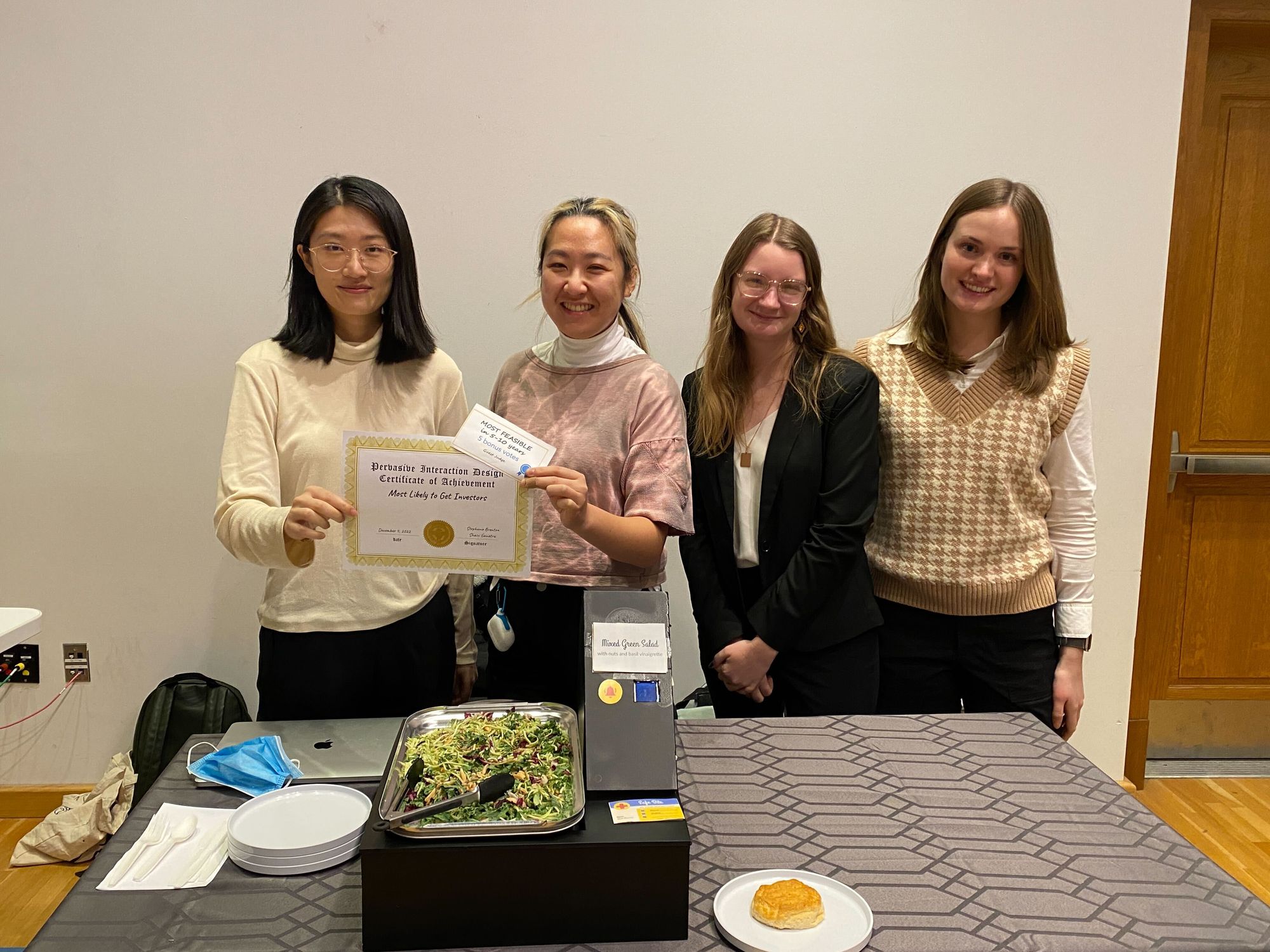
A picture of Group 2 following the in-class live demonstration. Awarded by peers as "Most Likely to Get Investors"
Appendix
Want to learn more about the process of researching and developing Safe Bite? Read our previous milestones:
Milestone 1 - Concept Proposal
Want to Talk?
Me too! Reach out to me about professional roles or just sharing your favorite anime (mine is Detective Conan):